
Latin America is a densely populated area of the world made up of some countries with stable political situations and others with significant political discord and economic challenges. As such, we draw your attention to a publication by Marino J González, a professor at the Simon Bolivar University in Venezuela in which the author aimed to “Describe the characteristics of the success and failure of Covid-19 vaccination policies in Latin America.”1
Figure 1 allows readers to appreciate the successes and failures of vaccine campaigns in Latin American countries.
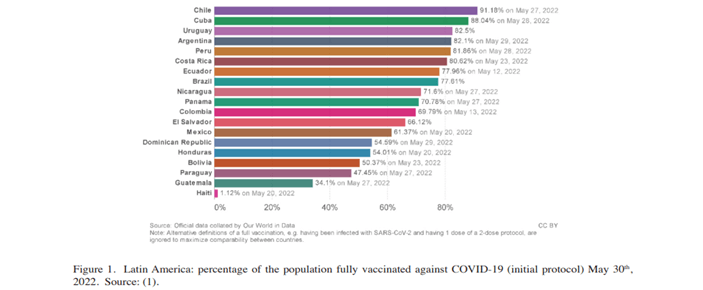
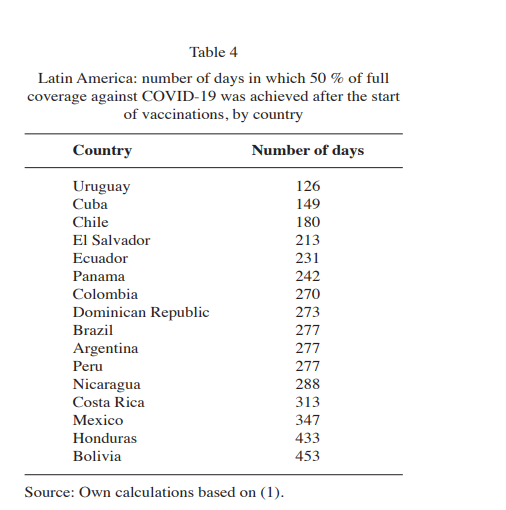
“…The number of days required for countries to reach 50 % full coverage after the start of vaccinations; three countries (Uruguay, Cuba, and Chile) took less than 200 days, while four countries (Costa Rica, Mexico, Honduras, and Bolivia) took more than 300 days. This gap illustrates the differences in performance among countries in the region. Countries that required fewer days can be considered more successful. Note that Chile, despite achieving 50 % coverage more quickly, was not the country that took the least time from the start of vaccinations. This country was Uruguay (requiring 126 days vs. 180 days in Chile – see enclosed table).
…Although Latin America has been the region of the world most affected by the pandemic, the specific characteristics of the countries have conditioned different levels of performance of the health systems. The analysis of vaccination policies indicates that there are countries with substantial successes as well as countries with notable failures. Elucidating the reasons for the successes and failures is of vital importance to deepen the positive aspects, and to introduce changes in the restrictions of health policies in the region.”1
You can read the complete article here.
References
- González R, M. J. (2022). Policy successes and policy failures in COVID-19 vaccinations in Latin American countries. Gaceta Médica de Caracas, 130(Supl. 2). https://doi.org/10.47307/gmc.2022.130.s2.6
Disclaimers
- The material in these reviews is from various public open access sources, meant for educational and informational purposes only
- Any personal opinions expressed are those of only the author(s) and are not intended to represent the position of any organization(s)
- No official support by any organization(s) has been provided or should be inferred