Two years ago, attitudes towards vaccinations were rarely discussed as it was considered a private matter. However, as Covid-19 made its way into the public eye and quickly evolved into a global pandemic, one’s vaccination status became a point of discussion on social media and in the real world. Vaccination campaigns started almost simultaneously in all western countries in January 2021, and people expressed their varying concerns with regard to vaccinations. The media offered a large platform to those more concerned with the potential risks of vaccinations without a great deal of emphasis on the lives saved by vaccines.
The enclosed picture, from the New England Journal of Medicine, is a dramatic visual illustration of the incidence of “vaccine hesitancy” throughout the United States.
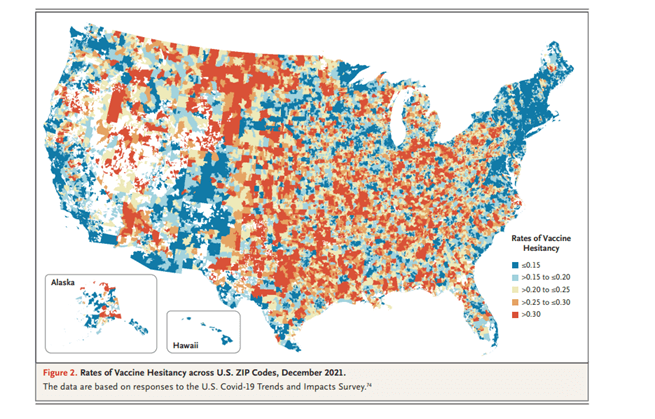
According to the New England Journal of Medicine, “Vaccine hesitancy is a state of indecision and uncertainty about vaccination before a decision is made to act (or not act). It represents a time of vulnerability and opportunity. Multiple surveys that were conducted to examine the sentiments concerning Covid-19 vaccination have exposed new levels of volatility around vaccine hesitancy, particularly when the hesitancy is powered by digital media platforms. Spikes in vaccine hesitancy often coincide with new information, new policies, or newly reported vaccine risks. Some of the variability is due to factors such as a decline in the public’s trust of experts, preferences for alternative health, political polarization, and belief-based extremism. In this review, we use the examples of hesitancy regarding the measles– mumps–rubella (MMR), human papillomavirus (HPV), and Covid-19 vaccines to look at the multifaceted issues that fuel vaccine hesitancy. Each of these examples is part of a larger, complex story.”1
“Physicians and health care providers are among the most trusted persons when it comes to health care advice. The Wellcome Global Monitor surveyed people in 140 countries and found that 73% of the respondents said that they would trust a doctor or a nurse more than others; the percentage was 90% in the higher-income countries.”1 So, we – as professionals involved in Medical Affairs – are deeply involved in the dissemination of correct information such that acceptance of vaccines is increasingly widespread while acknowledging patients’ perspectives as related to vaccine concerns. Maintaining an open dialogue with patients may lead to good results and have a significant impact on the community. an open dialogue with patients may have good results and a significant impact on the community.
Read the full publication here.
Disclaimers
- The material in these reviews is from various public open access sources, meant for educational and informational purposes only
- Any personal opinions expressed are those of only the author(s) and are not intended to represent the position of any organization(s)
- No official support by any organization(s) has been provided or should be inferred
References
- Larson, H. J., Gakidou, E., & Murray, C. J. (2022). The Vaccine-Hesitant Moment. New England Journal of Medicine. https://doi.org/10.1056/nejmra2106441