
The IQVIA institute, part of the IQVIA company, the largest global CRO, produces several reports related to pharmaceutical and biotech companies. Their latest report is devoted to biotech companies and the role they have on the research and development of new drugs. One key highlight of the report is that in the last twenty years, the share of EBPs in the R&D pipeline has doubled and is continuing to grow! This is indicated in the figure below.
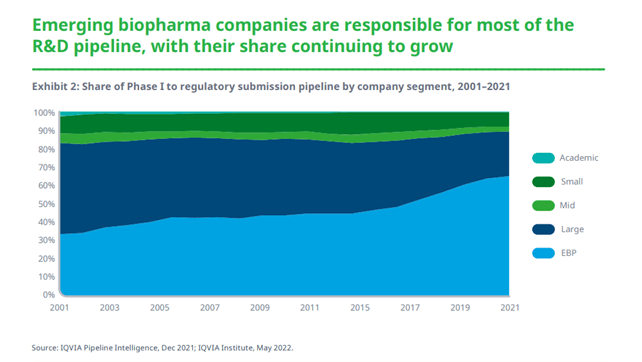
“The majority of biomedical innovation is developed by emerging biopharma (EBP) companies, many of which have never marketed a therapy before. Over time, those companies either successfully bring their products to market or, in many cases, their assets or whole companies are acquired by others. These EBP companies are at the root of early-stage drug development and their performance, the environment in which they operate, and their relationship to other stakeholders in the health system play a critical role in determining the future of many novel therapies and health technologies.”1
Here are some additional highlights:
- Emerging biopharma companies (EBPs) — defined as those with less than $500 million in annual sales and less than $200 million per year on R&D spending — are currently developing nearly 4,000 drugs, more than double the number in 2016 and representing 65% of the total drug development pipeline with an additional 7% being developed by EBPs in partnership with larger firms.
- Emerging biopharma companies are responsible for a record 65% of the molecules in the R&D pipeline without a larger company involved, up from less than 50% in 2016 and 34% in 2001.
- EBPs headquartered in China now account for 17% of the overall EBP innovation pipeline, up from 6% just five years ago, and compares to 20% coming from Europe-based companies and 46% from U.S.-based companies, both of which have lost share over the same period.
- The relative contribution of EBPs to the total pipeline by country or region reflects differing characteristics and maturity of biomedical innovation ecosystems around the world, and ranges from a low of 22% in Japan, 47% in Europe, 62% in the U.S. and 83% in China.
- A significant portion of oncology drug development comes from emerging biopharma companies with oncology representing 39% of the emerging biopharma pipeline and over 1,500 oncology products in development. There are over 600 EBP companies with oncology-only pipelines, including many with only a single molecule in development.
- Emerging biopharma are more focused in oncology, infectious disease and vaccines than their larger counterparts, but less in neurology and immunology.
We will continue to report on the findings of this report, but in the meantime, read more here.
References
- Emerging Biopharma’s Contribution to Innovation. (n.d.). IQVIA. Retrieved September 29, 2022, from https://www.iqvia.com/insights/the-iqvia-institute/reports/emerging-biopharma-contribution-to-innovation
Disclaimers
- The material in these reviews is from various public open access sources, meant for educational and informational purposes only
- Any personal opinions expressed are those of only the author(s) and are not intended to represent the position of any organization(s)
- No official support by any organization(s) has been provided or should be inferred