This year we celebrate the 70th anniversary of DNA discovery. The discovery in 1953 of the double helix, the twisted-ladder structure of deoxyribonucleic acid (DNA), by James Watson and Francis Crick marked a milestone in the history of science and gave rise to modern molecular biology, which is largely concerned with understanding how genes control the chemical processes within cells. In short order, their discovery yielded ground-breaking insights into the genetic code and protein synthesis. During the 1970s and 1980s, it helped to produce new and powerful scientific techniques, specifically recombinant DNA research, genetic engineering, rapid gene sequencing, and monoclonal antibodies, techniques on which today’s multi-billion dollar biotechnology industry is founded. Major current advances in science, namely genetic fingerprinting and modern forensics, the mapping of the human genome, and the hopes linked to gene therapy, all have their origins in Watson and Crick’s inspired work. The double helix has not only reshaped biology, but it has also become a cultural icon, represented in sculpture, visual art, jewelry, and toys.
There are many legends linked to this discovery. Here are two curiosities.
- When did the first announcement of this discovery take place?
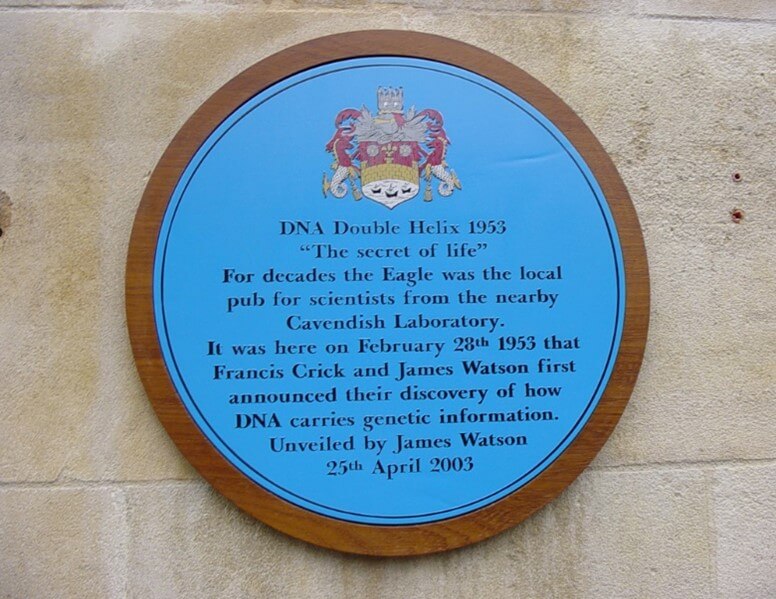
You may be surprised to learn that the very first announcement of the DNA structure did not take place neither in a scientific event nor in a publication! The first ones who were informed of this important discovery were the customers of the pub in front of the Cavendish laboratory. In February 1953, Linus Pauling and Robert Corey proposed a model for nucleic acids containing three intertwined chains, with the phosphates near the axis, and the bases on the outside. Watson and Crick completed their model, which is now accepted as the first correct model of the double helix of DNA. On 28 February 1953 Crick interrupted patrons’ lunchtime at The Eagle Pub in Cambridge to announce that he and Watson had “discovered the secret of life”. - Who is the scientist who gave a significant contribution to DNA discovery, but unfortunately was never included in any award?
Dr. Rosalind Franklin joined the laboratory of John Randall at King’s in 1950 with a PhD from Cambridge and X-ray diffraction experience in Paris. In May 1952 she and PhD student Ray Gosling captured an image of the double helix form (photo 51) giving James Watson and Francis Crick vital information for the building of their DNA model in March. Indeed, she helped to discover the story of life, and to lay the foundations of structural molecular biology, but after her sudden death in 1958 she was almost forgotten. The figure shows the famous photo 51.

Disclaimers
- The material in these reviews is from various public open-access sources, meant for educational and informational purposes only
- Any personal opinions expressed are those of only the author(s) and are not intended to represent the position of any organization(s)
- No official support by any organization(s) has been provided or should be inferred